You’ve come here looking for tricks to become ambidextrous, and the one at the top of your list is probably «write with your other hand». Let’s start by removing exactly that. Not because it’s hard, but because it’s the wrong move — and understanding why it’s wrong is already half the method.
Why it doesn’t work
«Writing with the other hand» won’t make you ambidextrous
The idea behind the trick is simple: if the weak side learns to do what the strong one does, you’re ambidextrous. But it hides a mistake. In the first article we saw that the weak side often isn’t unable: it’s disconnected. The hand moves, but the chain that should give it force and precision — shoulder, torso, opposite leg — doesn’t load. Training a disconnected side is like pressing the accelerator with the clutch down: plenty of noise, plenty of effort, and the drive never reaches the wheels.
You train for months, improve a little, get discouraged and conclude you’re «just not cut out for it». That’s not true: you were training the right thing in the wrong order. Before you build, you have to connect.
The first step
Before you train, connect
Connecting means one precise thing: checking that the weak side is part of a chain, not just that it «moves». These are two different things. An arm can lift perfectly well on its own and still stay mute when you ask it to transmit force, because it isn’t hooked to the rest of the body. Connection is what both paths — the one that adds and the one that removes — take for granted. Without it, nothing starts.
It’s also why Bilateral Education doesn’t begin with an exercise, but with an examination: first you look at whether the chain is there — whether it loads, transmits, sets down — then you decide what to do. Skipping this step is why most «do-it-yourself» attempts run aground.
Two paths
Additive or subtractive: it depends where you start
Once the side is connected, there are two ways to develop it, and they’re not interchangeable. The additive path builds the missing ability by training the weak side at the same task as the strong one: a footballer’s weak foot repeating the shot until it becomes reliable, a basketball player dribbling with the non-dominant hand. It’s targeted repetition, and it’s the right road when the weak side is connected but inexperienced.
The subtractive path does the opposite: it adds nothing. It releases a symmetry that is already there but blocked by a chronic tension — a contraction you’ve stopped feeling. Here you don’t build: you remove what stops the side from responding. It’s the right road when the side isn’t inexperienced, but held back.
Which of the two you need depends on where you start — and that’s exactly what the side test helps you understand in a minute. In practice, almost always, you need both: first you remove, then you build.
The session
A session in three movements
Here is the practical form, in its essential version — the full one is in the method. A session always moves through the same three movements, in the same order.
Remove. You begin by loosening: five release exercises taken from the Yang style of Taiji, read through a bilateral key. Not generic «relaxation», but letting the held tension migrate until the side becomes available again. It’s the movement that makes all the rest possible.
Build. Only now do you work on the specific gesture from the non-dominant side — the shot, the guard, the movement you need — with the side now connected and free. Here repetition finally takes hold, because it acts on a chain that truly loads.
Integrate. The last fifteen minutes are Taoist meditation: the form that holds together what you’ve removed and built, and lets it settle. It’s also the only part you can do on your own, five minutes a day.
Try it
Pouring without trembling
You can get a taste of «remove first» right now, in two minutes, with a narrow glass and a bottle of water.
- Pour water into a narrow glass holding the bottle with your non-dominant hand. Notice the tremor — and where it comes from: almost always in the shoulder, not the hand.
- Put everything down. Let your non-dominant arm drop by your side and, for one minute, with each exhalation imagine the shoulder becoming heavier and lower. Don’t push: let go.
- Take the bottle again with the same hand and pour once more, slowly.
The tremor has almost always decreased. In one minute you trained nothing: you removed a tension that was stiffening the chain. This is the first movement — and without it any repetition would start off crooked.
What to expect
The duck and the rabbit
Three things, said honestly. First: it’s task-specific. You become able to kick with both feet, or to hold your guard on both sides; you don’t become «ambidextrous in everything» overnight. Second: it’s not immediate — removing brings relief quickly, but the stable choice is exercised, like lucidity, and must be kept up. Third, the most important: the goal isn’t symmetry.
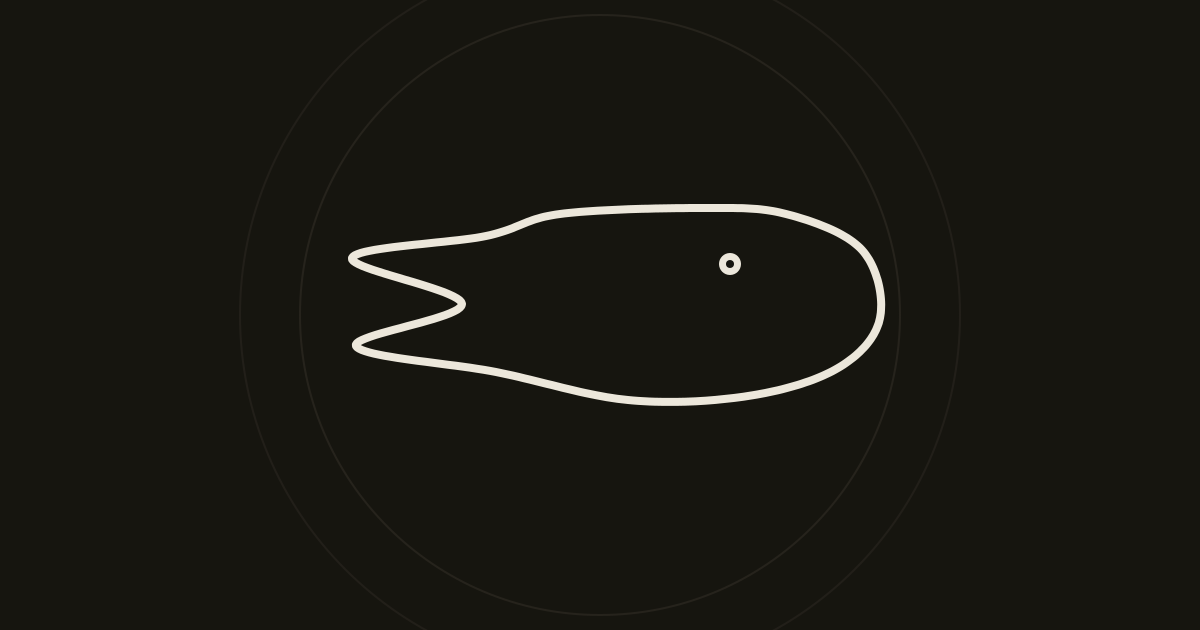
Look at the figure at the top of this page. It’s the duck-rabbit illusion: the very same image can be seen as a duck or as a rabbit. Becoming ambidextrous doesn’t mean fusing the two animals into one, nor choosing one forever: it means gaining the freedom to flip the aspect at will, to switch from one to the other when needed. Elective lateralization is this: not two identical sides, but the choice of which side to be, strike after strike. Writing with the other hand, the circus trick, tried to paint a third, hybrid animal. We’re not interested in the hybrid: we’re interested in the flip.
Where to begin
The first concrete step
If you want to really start, the order is this. First the side test, to know where you begin and which path you need. Then the method, for the full picture of the three movements. And, if you want to work on your own gesture with someone alongside, a session. If instead you’ve landed here without reading why ambidexterity isn’t «two equal hands», begin there: what is ambidexterity.
From the trick to the method
You won’t learn a trick. You’ll learn to choose.
The quickest way to stop circling around tricks is to start from the right point: the test tells you where from, the method how, the session with whom.