For fighters
You always start from the same stance. And your opponent knows it.
You can drill the weak side a thousand times and still be predictable. The problem isn’t the skill missing on one side: it’s the chain on the other that won’t let you leave.
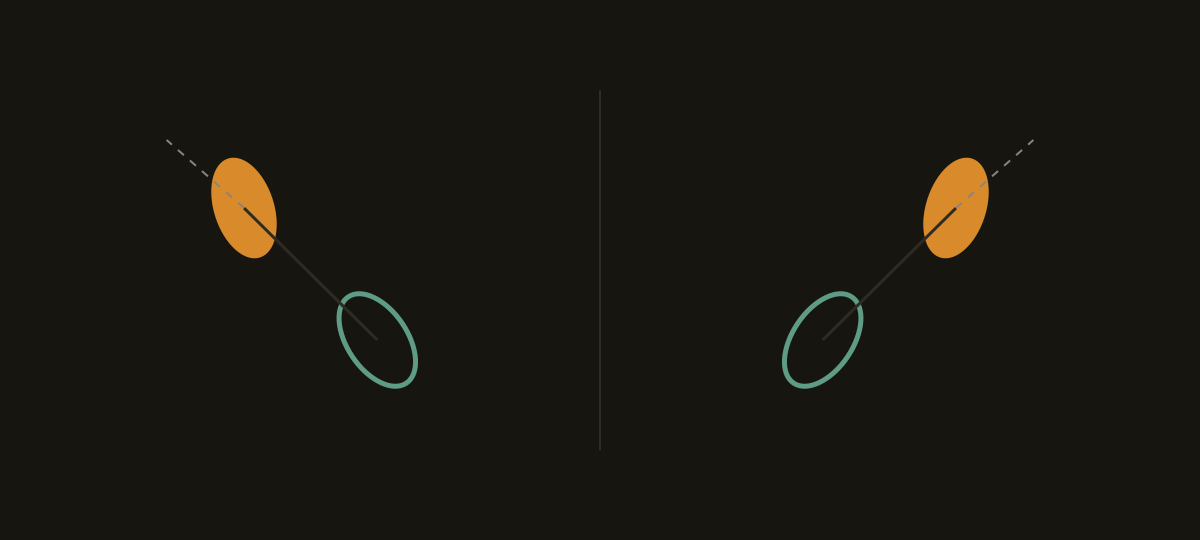
Two prices you pay every time
The first one you see in the ring: if the punch always starts from the same point, the person in front of you learns to read you within two rounds. They don’t need to be faster: they only need to know where you come from.
The second one you pay outside, and it arrives later: years of load always on the same side. The shoulder that pulls, the hip that wears down, the back that always complains in the same spot. It isn’t bad luck: it’s arithmetic.
Why switching stance doesn’t hold
You try moving to the other side and the same thing always happens: the first minute works, then the body goes back where it was. They tell you to insist, do more reps, drill the weak side. But reps don’t solve it, because the problem isn’t there.
A punch isn’t born in the shoulder: it’s born from the ground and travels through a chain that reaches the hand. When you switch stance, that chain has to be set down before the other one can load. If it isn’t, it pulls you back — and all you feel is that «it doesn’t come from the other side».
That’s why we don’t work on the weak side: we work on the strong one, so you learn to let it go.
Try it now, in twenty seconds
Standing, no gloves. Slowly shift your weight onto one leg, as if you wanted to lift the other. Slowly, no momentum.
If the starting leg lets you go, the weight passes and stays. If it doesn’t, at some point you feel a small tug pulling you back. That’s the rebound: the chain hasn’t been set down.
Do it on both sides and compare. In almost every case one side is clean and the other isn’t — and it’s exactly the side you can’t start from in the ring.
Three things decide where the punch starts
The stance
Which foot is forward. The choice you can see, and usually the only one anyone works on.
The chain
Which line carries force from the ground to the hand: the one crossing the front of the body or the one crossing the back.
The direction
Which way you travel along it. The choice nobody sees from outside, and the one that changes everything in the punch.
Three two-way choices make eight setups, not two. A fighter using only one is readable; one who can choose isn’t. The full structure →
How we work
A session lasts ninety minutes and isn’t training: no sweating and no hitting. First we release the tension that keeps the strong side glued, then we work on your gesture — your cross, your hook — starting it from the other side. At the end, fifteen minutes still so what you felt stays.
It doesn’t replace your coach and doesn’t touch technique: that stays their job. Here we work on the point technique starts from.
The first step is a session
Forty-five minutes on your gesture, no gloves and no commitment: we look at where the punch starts from and you learn to choose the side — the principle is the same one that then applies to your boxing.
Then, if you want to work on your own gesture, you don’t pay for the first one-to-one session unless it convinces you.
Do you coach at a boxing gym? I’ll bring an introductory session to your athletes, free →