The method
Not which side you start from. But whether you can change it.
You’re not right- or left-handed the way you’re tall or short. The side you start from is the result of three choices your body makes without telling you — and choices can be changed. Here’s how it works, from the beginning.
If you landed here without knowing what kind of work this is, the premise lives elsewhere: what harmonious movement education is →
01 — The chain
Every gesture moves a chain, not a muscle.
When you repeat a gesture — signing, driving, carrying the bag always on the same shoulder — a single isolated muscle doesn’t work. A chain does: a line of muscles that starts at a leg, rises diagonally across the trunk and ends at the opposite shoulder.
Repeated for years, always in the same direction, this chain shortens. And the tension it stores doesn’t leave when you stop: it stays there, ready for tomorrow’s gesture. That’s why a massage loosens the knot and three days later you find it again — the gesture that produced it is still in place.
The habitual gesture
The reversed gesture
For all this to work, though, the chain must be connected. The force entering from the ground reaches the hand only if the body is connected; in a disconnected body it dissipates into the joints. Look at the wave running down a whip: there is no whip first and wave after — the wave is the whip working. That’s why the first thing to look at is not which side you start from, but whether the chain is there at all.
02 — Tone
Not all tension is a problem.
The most common mistake is telling everyone to «relax». But a body without tension isn’t free: it’s a body that can’t stand up and transmits nothing. Tension has three different states, and only one should be let go.
Stiffness necessary
The pre-tension that lets force cross the body. It’s needed, in the right amount. Listen to a guitar string: slack, it doesn’t play softly — it doesn’t play at all. It shouldn’t be tightened to the max — it should be tuned.
Connecting tension structure
The tension a chain holds while it’s working. Feel the cable of a suspension bridge: it’s taut, but that tension is what holds the bridge up. Relaxing it doesn’t free it: it makes it fall.
Orphan tone to set down
The tension left over when the gesture is already finished. This one should be let go. It’s chronic co-contraction: a chain that has stopped working but hasn’t released its grip.
The method works only on the third. Telling it apart from the other two is already half the work.
03 — The three choices
Not two sides. Eight ways.
We tell ourselves the body has only two possibilities: right or left. In fact every gesture arises from three separate choices, made in an instant without consulting you. None comes before the others: they are three parallel axes.
Axis one
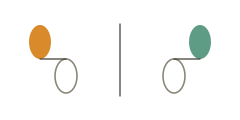
The stance
Which leg is forward. The most visible choice: you can see it from the feet. Watch anyone standing and waiting — one foot is always slightly ahead, and it’s almost always the same one.
leftright
Axis two
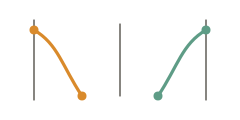
The chain
Which chain descends into the opposite leg: the one crossing the front of the body or the one crossing the back. Two different roads for the same force.
frontback
Axis three
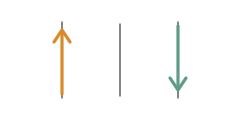
The direction
Which way energy runs along that chain: from the ground up, from leg to trunk, or from the top down. Feel the difference between a movement that rises from the ground and one that descends from the shoulders.
risesdescends
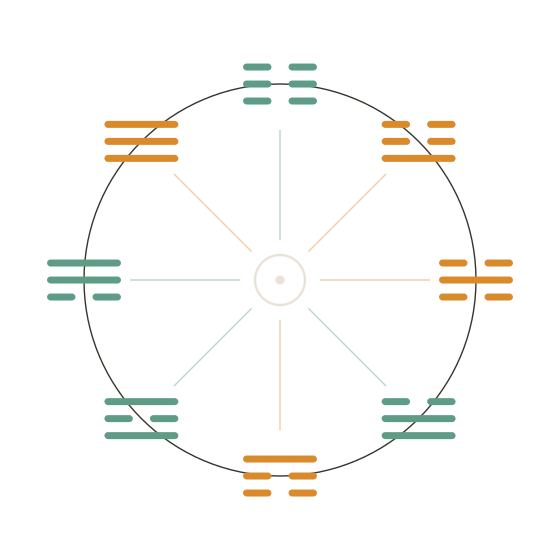
four on one sidefour on the other
Two by two by two makes eight. And here’s what changes everything: being right- or left-handed is none of the three choices taken alone. It’s the result of how they combine. Change a single choice — even just the direction, keeping everything else still — and the side flips. Change two, and it goes back.
side = stance ⊕ direction ⊕ chain
One choice changed flips the side · two bring it back
This line says something simple: none of the three choices, on its own, tells you which side you’re on. Only all three together. And it’s a prediction you can test on your own body, not a symbol: change one and feel whether the side really flips.
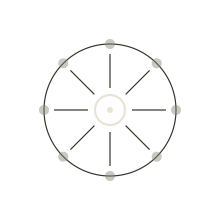
Eight configurations around a centre: the same figure an ancient tradition has drawn for millennia, the eight trigrams of the Yijing. We didn’t go looking for it — the body produces it. I’ve written about it here → · The full structure is in the research →
04 — The centre
There is a ninth place: the instant before you’ve chosen.
Around the eight configurations there is a ninth place, and it isn’t a ninth position. It’s the moment when no chain is switched on yet: the leg is unloaded, the movement hasn’t started, and all eight remain open.
Feel what it is, with an image: someone about to throw a ball who hasn’t yet decided where is, for an instant, ready for every direction. As soon as they choose, the others close. That before is the centre.
In the method this instant is called connection, and it’s the point of the whole work. It’s neither adding force nor removing tension: it’s the condition that makes choosing possible. Whoever learns to stay in it doesn’t own eight skills: they hold the centre, and from there every movement is one step away.
05 — Three degrees of freedom
Where you are right now, inside this structure.
Not all bodies inhabit the eight configurations in the same way. These aren’t three faults to correct: they’re three degrees of freedom, one inside the other.
First degree
The slack — has the chains, but doesn’t connect them
Beware an easy misunderstanding: the slack body is not weak or empty. Its chains are active, they’re there. What’s missing is the connection: it doesn’t go along with them, doesn’t let them transmit. It has the parts but doesn’t make them work together. No need to build force it already has: it needs to learn to go along with what it has.
can’t connectSecond degree
The anchored — one configuration only, and can’t change it
It already has what the slack body lacks: it connects, switches on a chain, chooses a side. It has truly entered the structure. Its limit is different: it can’t let go. Further along than the slack body, because it’s connected; further back than the elective one, because it isn’t reversible.
can’t let goThird degree
The elective — holds the centre and opens the one it needs
The elective body too, while moving, is in a precise configuration: the body can’t be in two places at once. The difference isn’t where it is, but where it comes from and how freely it leaves. The anchored body sits in its position; the elective one passes through, holding the centre. Frozen in a photo they look alike; in movement you tell them apart at once.
enters and leavesThe two ways of failing mirror each other: the slack body can’t connect, the anchored one can’t let go. One can’t get in, the other can’t get out.
The signal that tells them apart: the rebound
Feel it yourself, now. Standing, slowly shift your weight onto one leg, as if to lift the other. If the starting leg lets you go, the weight slides onto the other and stays. If it doesn’t, at some point you feel a small tug pulling you back: the body rebounds onto the first leg, like a stretched elastic snapping. That rebound is the signal that the chain hasn’t been set down.
And something important, which stops you mistaking a beginner for a blocked body: at the start, rebound is normal. When a body begins connecting its chains it does so badly, clumsily. That’s the passage, not the problem. The difference between someone learning and someone anchored can’t be seen in a pose: it shows over time — in one it passes, in the other it stays.
06 — The practice
Three movements, and the order isn’t negotiable.
Whether you work for a quarter of an hour or ninety minutes, the shape of the work is always this. The order matters: you can’t build on a body that hasn’t first let go, and you can’t make anything stay that you haven’t integrated.
Remove
First we release the tension the body drags along for no reason — the kind that serves nothing and takes up space. A handful of release exercises drawn from Taiji, from a school I’ve practised for over ten years, reread for one purpose only: to free the movement, not to teach you a discipline.
Build
Then we work on the gesture: we watch where it starts when you do nothing to change it, and try to start it from the other side. At first it’s clumsy, and that’s fine. We don’t correct posture: we change where the movement is born. This is the part that changes from person to person.
Integrate
Finally a few minutes standing still, with attention on the whole body. It’s the part that seems least useful and it’s the one that makes everything else stay. It’s also the only one you can redo alone, five minutes a day, without me.
Try it now
The first session, to do now.
Ten minutes, a clear floor and bare feet are enough. No load, no effort: if you expect a workout, you’ll be disappointed.
- Standing, shift your weight from one leg to the other very slowly. Look for the exact point where you stop being on the first leg, before you even arrive on the second. If that point isn’t there — if you’re still on the first when you’re already on the second — you haven’t shifted the weight, you’ve doubled it. Finding that point is already half the exercise.
- Walk normally for a few steps, without changing anything. Notice which leg begins the step and which closes it by carrying the weight.
- Now reverse: let the step be started by the leg that usually closes it. Walk like this for a minute. Don’t correct the clumsiness: just notice where you’re holding.
- Go back to normal walking. Something, in your back or neck, has shifted. You didn’t do a workout: you asked a chain to let go of its grip.
The five real release exercises come from Yang-style Taiji and are learned in person. This is the taste: the principle in one minute.
One last, honest thing
It’s exercised, not possessed.
The freedom to choose which side to start from isn’t a state you win once and for all. It’s like lucidity: you keep it as long as you exercise it, and it fades the moment you stop. No one promises you a permanent result in three sessions.
And this is movement education, not therapy: if you have acute pain or an ongoing diagnosis, see a doctor first. The method is explained in full in the research, with sources — you can read it before writing to me.
One body • Two sides • One choice