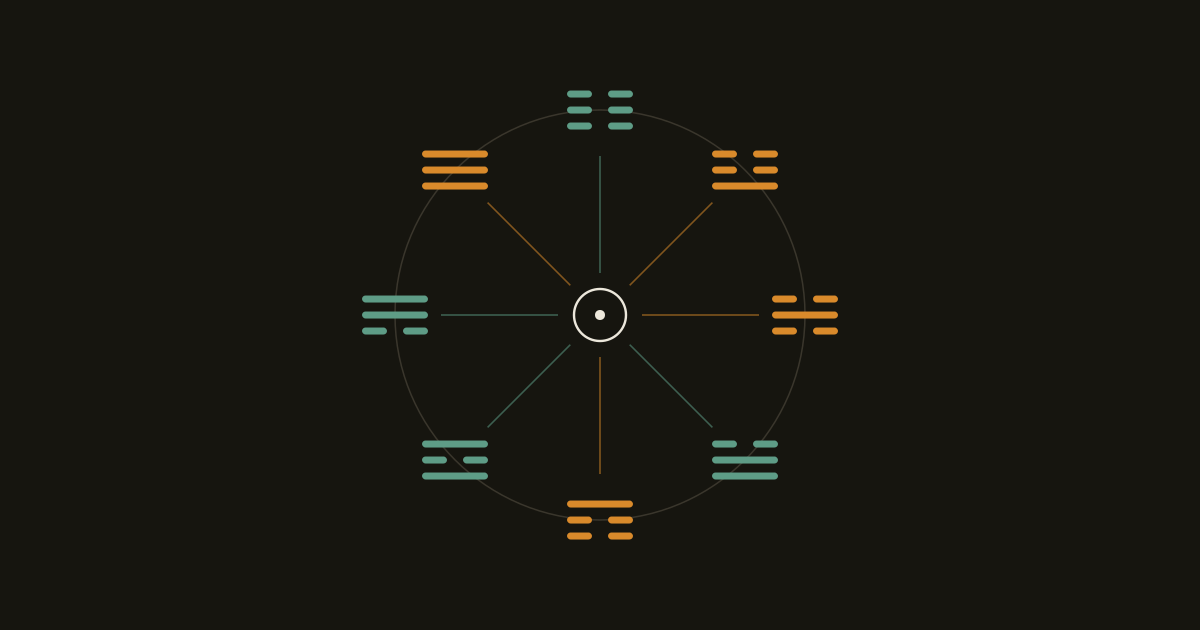
In short. Every gesture arises from three independent choices of the body: which leg is forward (stance), which muscular chain descends into the opposite leg (front or back), and in which direction energy travels along it (bottom-up or top-down). Three two-way choices give eight configurations, arranged around a ninth place: the instant before you’ve chosen. Being right- or left-handed is none of the three choices, but their combination — and it’s the same structure as the eight trigrams of the Yijing.
When I started looking closely at how the body decides which side to start from, I wasn’t looking for any ancient figure. I was just trying to count: how many real possibilities does a standing body have, before it moves. The number that came out — eight, arranged around a centre — is the same one a Chinese tradition has been drawing for millennia. It’s worth telling how you get there, because the interesting part isn’t the coincidence: it’s the way the body gets there on its own.
How many possibilities does a body really have before it moves?
Common sense says the body has two possibilities: right or left. But if you look at any gesture — a step, a push, a strike — the separate choices are three, and each has two ways.
The first is the stance: which leg is forward. The second is the chain: which muscular line descends into the opposite leg, the front one crossing the front of the body or the back one crossing the back. The third is the direction: which way energy travels along that chain, from the ground up or from the top down.
They really are independent, and there’s a simple way to check: keep two choices fixed and try changing the third. If you can, that third is a real choice and not another one in disguise. Three choices, two ways each: two by two by two makes eight.
Why exactly eight? The doubling ladder
This is exactly how the Yijing builds its figures. You start from a line that can be one of two kinds, unbroken or broken. Stack two: four combinations. Stack three: eight. Every added line doubles, because it can go one way or the other on each figure already there.
Those eight three-line figures are the trigrams, the bagua. And the body, counted by axes, does the same thing: stance, chain and direction are three lines, each with two states, and their combinations are eight.
Where does laterality sit, if not in a single choice?
Here’s the point that convinced me the analogy wasn’t decorative. In a trigram the meaning never sits in one of the three lines: it emerges from how they stand together. In the body the same happens with laterality.
Being right- or left-handed is not the stance, is not the chain, is not the direction. It’s their combination. Change just one of the three — even only the direction, keeping everything else still — and the side flips. Change two, and it returns to how it was, because two flips cancel out.
This has a consequence beyond geometry: laterality isn’t a property the body owns, it’s a relation the body holds up. And a relation, unlike a physical trait, can be changed.
What is the ninth place, the centre of the eight?
In the bagua the eight trigrams are arranged around a centre, and that centre isn’t a ninth trigram: it’s what the other eight are directions in relation to. In the body it’s the same, and it’s a moment you can feel.
It’s the instant when no chain is switched on yet: the leg is unloaded, the movement hasn’t begun, and all eight configurations stay open. Someone about to throw a ball who hasn’t decided where is, for a moment, ready for every direction. As soon as they choose, the others close. That before is the centre — and in the method it’s called connection.
Does the bagua prove anything? An honest clarification
It’s worth saying clearly what this correspondence is not. It isn’t proof: the fact that an ancient tradition drew eight figures around a centre proves nothing about how a body works today. Nor is it an endorsement: no divination or symbolism is practised here.
It’s something more modest and, to me, more interesting: a ready-made language for a structure the body produces by itself. When you count the real freedoms of a standing body, you get eight states and a centre. That someone, long ago, already had an elegant way to write that same structure is a piece of luck — not an argument.
The proof, if anything, is elsewhere: take your body, keep two choices fixed, change the third and feel whether the side really flips. If it does, the structure holds. If it doesn’t, no ancient figure will save it.