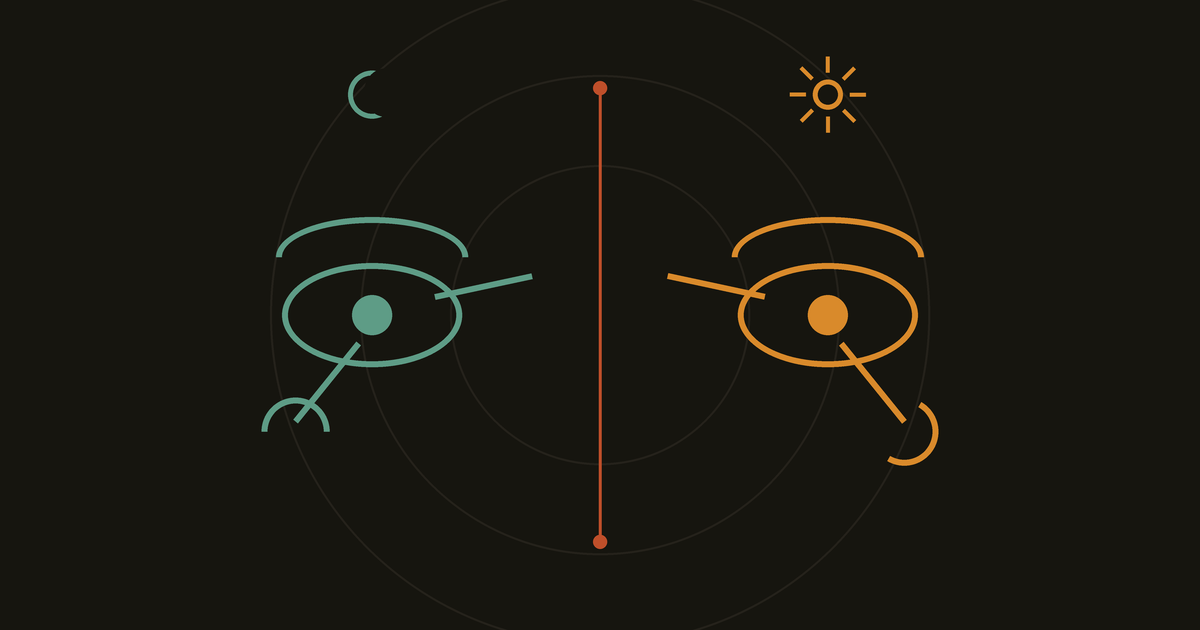
The Eye of Horus is the left eye, lunar: a symbol of healing, protection and restoration — the eye wounded by Set and made whole again by Thoth. The Eye of Ra is the right eye, solar: a symbol of power, authority and wrath, acting as an autonomous goddess. They’re not the same symbol under two names: they’re two sides of sight with two opposite functions — one protects, the other strikes.
There’s a question almost no one asks in front of an Egyptian eye: why two? Why did a civilization obsessed with order and symmetry not leave a single, universal eye, but draw two — and place them on opposite sides, with opposite powers? The answer to that «why two» is more interesting than any pendant-shop esoteric meaning.
The symbol
What the Eye of Horus means
The Eye of Horus — in Egyptian wedjat or udjat, «the whole eye», «the healed one» — is born from a myth of violence and repair. In the struggle for the throne, Set tears out Horus’s eye; the god Thoth finds it and puts it back together, piece by piece. The eye made whole again becomes the symbol par excellence of what, after being shattered, was made one once more.
That’s why the wedjat, for three thousand years, was the amulet of health, protection, healing — painted on the prows of boats, laid on the wrappings of the dead so the body would return whole in the afterlife. It isn’t the eye that sees: it’s the eye repaired. Keep it in mind, because it’s the detail that matters most of all.
The difference
Eye of Horus and Eye of Ra: what’s the difference
Here the most common confusion nests. The clean way to put it: the Eye of Horus is the left, the Moon, healing; the Eye of Ra is the right, the Sun, power. The Egyptians often called the Sun and Moon the «eyes» of the sky: the right eye solar, the left eye lunar. In time the lunar eye became the Eye of Horus, the solar one the Eye of Ra.
And the functions are opposite, almost mirror-image. The Eye of Ra isn’t passive: it’s the burning, active aspect of the sun-god, a force that goes out and strikes, often personified as a lioness goddess — Sekhmet, Hathor, Bastet — sent to punish disorder. Put bluntly: the Eye of Horus protects you, the Eye of Ra strikes for you. One receives and heals; the other projects and burns.
An honest note, because seriousness demands it: this neat left-right, moon-sun division is largely a modern simplification. In the ancient sources the picture is more fluid — the word wedjat was applied to the eyes of several deities, and the two eyes sometimes swapped or merged. But this very fluidity, as we’ll see, is part of the point.
Two sides
Right and left: why the Egyptians gave sight two sides
Let’s pause on the bare fact, before any interpretation: the Egyptians didn’t think of sight as one. They thought of it as a pair of functions, assigned to two sides and two heavenly bodies. One side that stabilizes, measures, heals (the Moon’s eye, that waxes and wanes with measure); one side that acts, projects, strikes (the Sun’s eye, constant and powerful).
It’s exactly the structure Bilateral Education finds in the body. The neuroscientist Robert Sainburg calls it complementary dominance: the two sides don’t do the same thing redundantly — one specializes in quick, direct gestures, the other in stability and control. As we describe in what is ambidexterity, the stake isn’t having two identical sides: it’s the right relation between two different ones. The Egyptians, with Moon and Sun, had already drawn that relation on the face of a god.
Loss and restoration
The eye that is lost and made whole
Let’s return to the wedjat, to the wounded and restored eye. There’s a hidden image in that myth, and the Moon makes it plain: the lunar eye is lost and returns. The Moon wanes until it vanishes, then waxes until it’s full. Horus’s wound and his healing are the lunar cycle made story: a function — light, sight, power — that migrates away from one side and comes back to it.
Feel this word: migrate. In Bilateral Education it’s the heart of release: tension doesn’t «switch off», it moves; tone is a loan, not a property. The wedjat says the same thing in mythical language: wholeness isn’t a fixed state to possess, it’s a relation that can be lost and made whole again. Not the eye that never gets wounded — the eye that, wounded, knows how to make itself whole.
The guard
Change guard, change gaze
And here comes the question this article was born from: if I change guard, does the way I see change too? The answer, properly stated, is yes.
Beware a misconception, though. The anatomical blind spot — the optic disc, where the nerve leaves the retina — doesn’t move: it’s fixed in each eye, and with both eyes open one covers the other’s gap. That doesn’t migrate with the guard.
But there’s a second «blind spot», and it’s the one that counts. Watch a boxer or a fencer: the guard decides which eye leads — the aiming eye, the one in front that conducts — and which side stays uncovered, the flank the opponent can strike unseen. In a right-hander in normal guard, one eye leads and one side is your blind side. Switch the guard, and both switch: the eye that was leading goes to the back, the uncovered side moves to the other flank. The optic disc doesn’t move: the office of seeing shifts — who leads, who covers, who stays exposed.
The inversion
If the eyes invert
Now we can close the circle. If in the Egyptian pair one eye holds the solar office — to act, strike, lead — and the other the lunar office — to receive, measure, heal — then inverting the eyes means swapping those offices: making the eye that received now lead, letting the eye that struck now rest.
And the myth, surprisingly, doesn’t forbid it: it tells it. The Eye of Horus and the Eye of Ra swap, blur, are sometimes the same wedjat. That «fluidity» an honest historian is forced to admit isn’t a flaw in the sources: it’s the sign that the offices aren’t nailed to one eye forever. Light can sit on the right or the left; power can pass to the other side.
What does it entail, then, to be able to invert the eyes? Exactly what Bilateral Education calls elective lateralization: not abolishing one side’s dominance, but being able to choose which side leads. The wedjat — the eye «made whole» — is not, in this reading, a single eye: it’s the restored relation between two eyes able to trade the task. Wholeness isn’t fusing the two into one, nor freezing one as dominant. It’s the capacity to recompose the relation, and to lead with one or the other as needed.
Let it be said clearly: this is a reading, not a historical thesis. The Egyptians knew nothing of the dominant eye or interhemispheric inhibition. What is documented is that they assigned the two eyes opposite sides and opposite functions, and made loss-and-restoration the heart of the symbol. Reading all this as a model of choosing the side is our step — declared, and therefore testable: it falls if the functions are shown to have been fixed and never interchangeable. The sources, instead, say the opposite.
Try it
Try it yourself
You don’t need a temple. You need a finger.
Hold a finger up at arm’s length, lined up with a distant object. Look with both eyes. Now close the left eye: does the finger jump sideways? Reopen it and close the right: does it jump the other way? One of the two jumps will be small — that’s your leading eye, your solar eye. The other is the eye that, in this reading, receives. Neither is better: they’re two offices. And noticing which one leads is the first step toward being able, one day, to choose.
FAQ
Frequently asked questions
What’s the difference between the Eye of Horus and the Eye of Ra?
The Eye of Horus is the left eye, linked to the Moon, and symbolizes healing, protection and restoration. The Eye of Ra is the right eye, linked to the Sun, and symbolizes power, royal authority and divine wrath. In short: the Eye of Horus protects, the Eye of Ra strikes.
Is the Eye of Horus the right or the left eye?
It’s the left eye, the lunar one. In the myth it’s the eye Horus loses in the clash with Set and that is later made whole. The right eye, solar, is associated instead with Ra.
What does the Eye of Horus symbolize?
Well-being, health, protection and above all restoration: it’s the eye «made whole» after being wounded. That’s why it was used as a healing amulet and as funerary protection, so the body would return whole.
Are the Eye of Horus and the Eye of Ra the same thing?
Not exactly, but they’re closely linked and in the ancient sources they sometimes swap. Both are called wedjat and represent two complementary aspects of sight: one lunar and protective, the other solar and powerful.
Why is the Eye of Horus linked to healing?
Because it’s born from a myth of repair: the eye torn out by Set is made whole again by Thoth. It doesn’t represent an eye that never gets wounded, but an eye that, wounded, is made whole once more.
In short
In short
The Egyptians didn’t leave one eye but two — on opposite sides, with opposite powers — and made the most famous of them, the wedjat, the symbol of an eye made whole after the wound. Read with the eyes of Bilateral Education, that pair says one thing only: sight, like the body, has two sides with two offices, and its wholeness isn’t symmetry but relation — which can be lost, made whole, and, in the end, chosen.
If this weave of body and symbol speaks to you, you’ll find the same logic read through Taoism in Taoism and the two-sided body, and its theoretical root in the research. One body, two sides — and two eyes that, like Horus and Ra, are only waiting for someone to learn to trade them.
From symbol to body
Two eyes, two sides — and the choice of which to let lead.
The symbol says it in myth; the method teaches it to the body. The first step is to notice the leading side — and for that there’s the method, and, if you like, a session together.