No ancient thought describes the bilateral body better than Taoism: not two forces at war, but two poles that keep each other alive. And Taiji — the art born from it — heals precisely by removing, not adding. It is from here that Bilateral Education takes one of its most exact images, and one of its five release exercises.
The image
Yin and yang: the axis before the choice
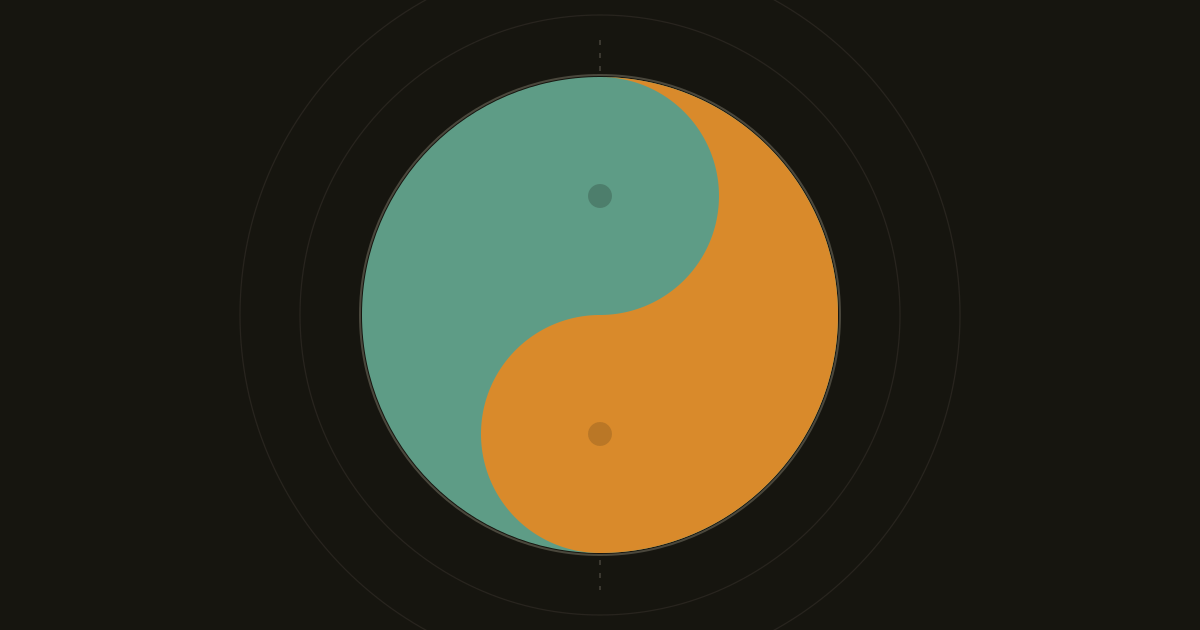
The taijitu, the yin-yang symbol, has a 180-degree rotational symmetry: turn it half a revolution and it returns identical to itself, and each half carries the seed of the other. It is the most exact image of the bilateral body — two sides that neither cancel nor merge, but hold each other in dynamic balance. Not one dominant and one suppressed: two poles, one axis.
The text
«Know the masculine, keep the feminine»
In the Tao Te Ching, chapter 28, Laozi invites us to know the masculine yet keep the feminine, to know the white yet keep the black. It is not a choice between the poles: it is holding both available, without favouring one. Read through the eyes of the body, it is the very definition of elective lateralization — the freedom to choose a side rather than suffer it.
Then there is pu, the uncarved wood. Habit «carves» us into a dominant hand, amputating the other side; Taoism invites a return to the uncarved block, where both sides remain possible. «The great carving cuts nothing», says Laozi: true form removes none of what was already there.
The principle
Remove, don’t add
Two Taoist words name the subtractive mechanism precisely. Wu wei, non-forcing: acting without contrary effort. And sung (鬆), release: letting held tension fall. The weak side is not built through sheer repetition — that is the additive path. It is revealed by dissolving the chronic co-contraction that kept it mute.
«The soft overcomes the hard» is not poetry: it is a description of what happens when inhibition eases and the latent symmetry resurfaces.
Try it
One minute of sung
The most direct way to understand the subtractive path is to feel it. This small experiment adds nothing: it only removes.
- Standing or seated, let your arms drop by your sides and close your eyes.
- Bring your attention to your shoulders: notice if one is higher or tighter than the other. Don’t correct it — just notice it.
- With each exhalation, imagine the weight of your arms increasing by one gram. Don’t push down: let them fall on their own.
- After a minute, open your eyes and slowly raise both arms out to the sides.
The side that before was «holding» now moves more freely. You didn’t add strength: you removed a tension you didn’t know you had. This is sung — the release that makes available what was blocked.
The practice
A lineage that heals by removing
The practice from which Bilateral Education’s subtractive approach comes has a precise genealogy: Yang Luchan, Cheng Man-ch’ing, Huang Sheng-Shyan, Patrick Kelly. A method where you first learn to move loose, then to release and align, and only at the end to find the forces — always starting from removing.
There is a historical irony that closes the circle. The Yang style was born soft out of necessity: at the imperial court, Yang Luchan removed from the Chen style the jumps, the stamps and the explosive release of force, to adapt it to nobles unused to exertion. Softness was not added: it was obtained by removing hardness. A century later, his grandson Yang Cheng-fu turned it into a health system for the people. From court art to care for all, the thread is always the same: sung, release.
Honesty
An analogy, not a proof
A clarification, in the spirit of the research. Taoism doesn’t «talk about ambidexterity»: it talks about the balance of opposites, non-forcing, integrity. It is we who read it through the bilateral body. This link must be kept at its own level — a phenomenological and conceptual connection, not empirical proof of the mechanism. Symbolic symmetry is a language and an image for describing the subtractive path, not its demonstration. Saying so openly makes the bridge stronger, not more fragile.
Does this weave speak to you?
Everything you read here comes from a single principle.
Taoist philosophy, Taiji and the bilateral body: if this dialogue speaks to you, the most concrete step is the method — and, if you like, a session together.