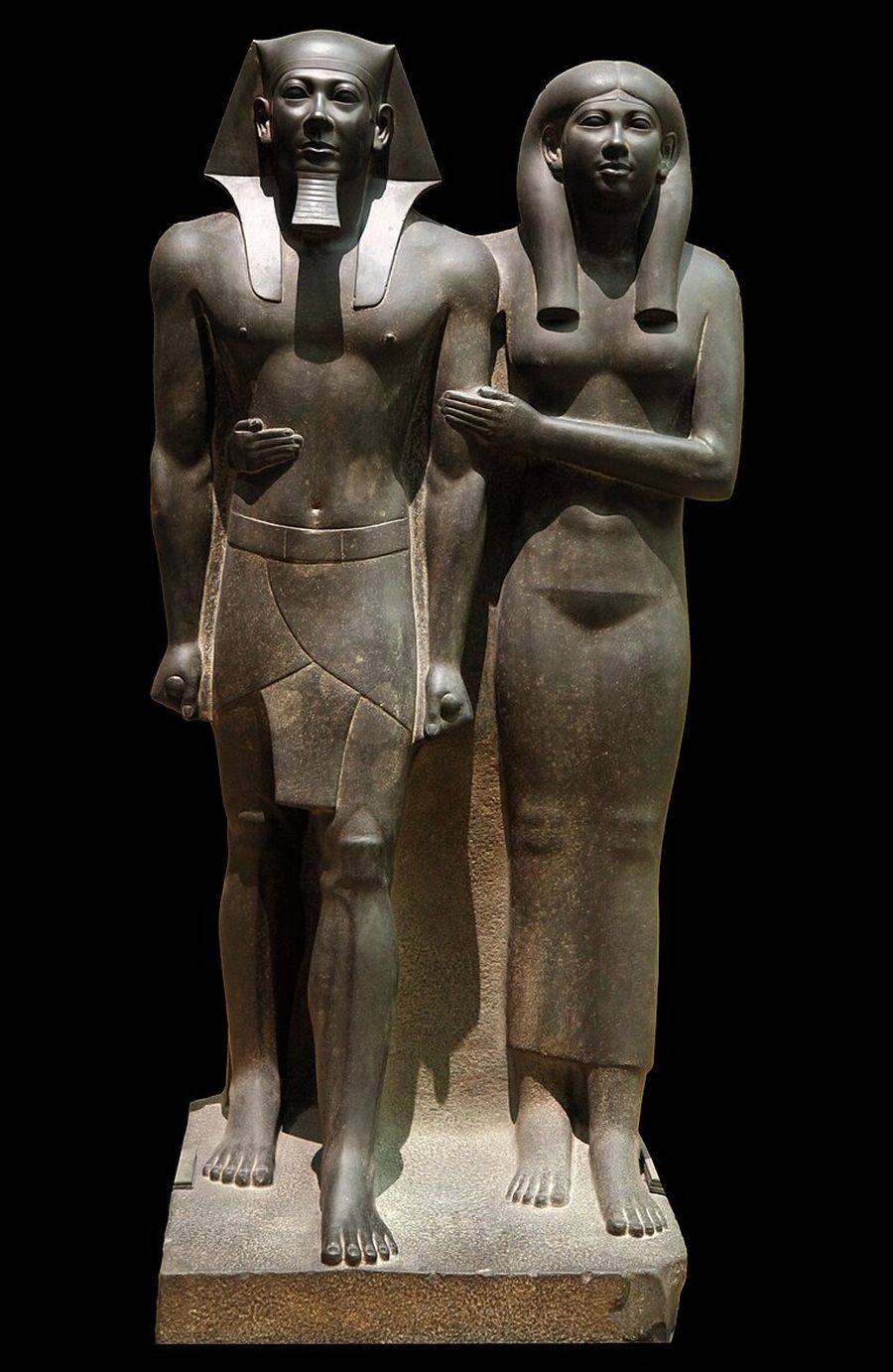
In short. The pharaoh stands frontal, shoulders level, fists closed at his sides. And the left foot forward. The stance is declared, but the weight doesn’t follow: no pelvis rotates, no shoulder loads. The stride is announced and never completed — and it’s a holding you can test on your own body in ten seconds.
Museum of Fine Arts, Boston, Egyptian gallery. A greywacke group a little over a metre forty tall, carved around 2500 BC and found in 1910 by George Reisner in the valley temple of Menkaure’s pyramid at Giza. The pharaoh and a woman with one arm around him — probably queen Khamerernebti II, though the statue bears no inscriptions and the identification remains a hypothesis.
What interests me isn’t who they are. It’s how they stand.
The false stride
Art historians have a name for this pose: the false stride. The left foot is advanced, but the rest of the body contradicts that step. The shoulders are perfectly level. The pelvis doesn’t rotate. The arms fall symmetrically at the sides, fists closed the same way. The torso is frontal as if the feet were together.
It’s a convention: in Egyptian statuary the standing male figure almost always advances the left leg, and the traditional explanation links it to the heart, and so to life. But the point, for us, isn’t the symbolic reason. It’s that the step is never completed.
In our grammar
In Bilateral Education a gesture comes from three choices: which foot is forward (the stance), which line carries force from the ground (the chain), and which way it travels along it (the direction).
Here the stance is declared unmistakably. But the direction is missing: no energy rises or falls along a chain, no pelvis rotates, no shoulder loads. And without direction, the stance remains a statement, not a movement.
Try it: ten seconds standing
Stand up. Advance your left foot about twenty centimetres. Now refuse to shift a single gram of weight onto it: the weight stays centred, exactly as before. Keep your shoulders level, your pelvis still, your arms relaxed at your sides.
Count to ten. Then notice where you’ve gone to tighten.
Almost everyone feels it in the same two places: the groin and the trapezius. They’re the muscles holding still a position the body would like to resolve — because a foot forward is an invitation, and not taking it costs work.
That work has a name in the method: orphan tone. Tension that stays switched on with no task left, because the gesture that called for it never arrived.
Above and below
But here the statue does something I hadn’t expected: it splits in two. And the gap between its halves isn’t a sculptor’s failure — it’s what makes it readable.
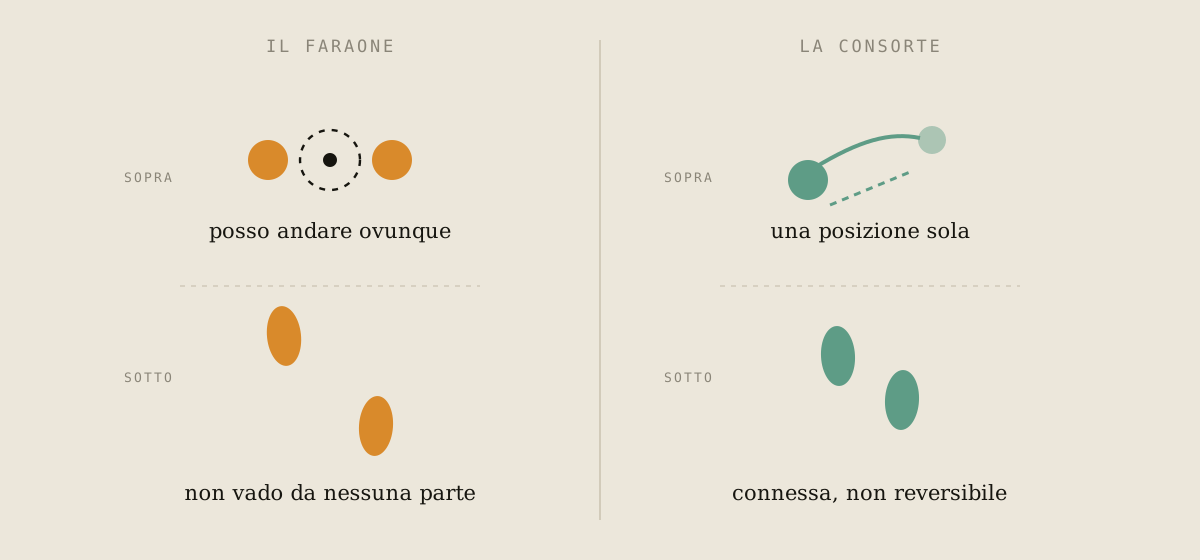
Above the belt there is no dominant spiral: we can’t tell whether the right or the left side leads, because neither does. That symmetry isn’t a holding: it is the photograph of the instant of the rebound, the moment when the weight hasn’t chosen yet and precisely for that reason every position is available. It’s the centre, not rigidity.
Below the belt, instead, he is anchored: the forward foot is a fixed position, and it isn’t reversible.
The upper half says I can go anywhere. The lower half says I go nowhere. The sculpture holds both together and makes both eternal: access to every position, and the limit of a body that must after all inhabit one. Below remains the memory of the pharaoh’s flesh — what in him was mortal, made immortal.
The consort: one position, not the centre
We know less about her, and not only her name. But one thing is visible: above the belt she isn’t symmetrical. Her right arm passes behind, around the pharaoh’s waist; her left hand rests on his arm. Two different chains, one passing behind and one in front, converging on a single function: to support and to present. And the direction is ascending, from below upward.
If that’s so, she doesn’t inhabit the centre: she inhabits a precise position. Not all of them, one — but lived, and reproducible: you can take that pose and feel it from inside, which you can’t do with the pharaoh’s upper symmetry.
Which leads to a conclusion worth stating in full, uncertainty included: we cannot know whether she reached elective lateralization, but the fact that she isn’t symmetrical above suggests she didn’t. In this statue, the centre belongs to him.
This is a reading, not a claim about the intentions of Egyptian sculptors: those we don’t know. But if the grammar is good for anything, it must work here too — and here it distinguishes two ways of standing that the eye perceives before it can name them.
Where it sits, among the four regimes
An image isn’t bilateral because it shows two sides: every body has two. It is when it makes a choice visible — which side starts, which supports, and whether that distribution is reversible or has been fixed once and for all.
And here the statue does something rare: it sits in two regimes at once. Below the belt it is fixed asymmetry — the choice declared and no longer revocable. Above it is suspension — the instant before assignment, when every position is still open.
I know of no other image holding both regimes in the same body. And it makes sense that it happens in funerary sculpture: it had to guarantee a position for eternity, and at the same time the fact that this body had been alive. The centre above and the limit below, made immortal in the same granite.
The consort, instead, stands entirely in fixed asymmetry — above and below. One position only, but inhabited.