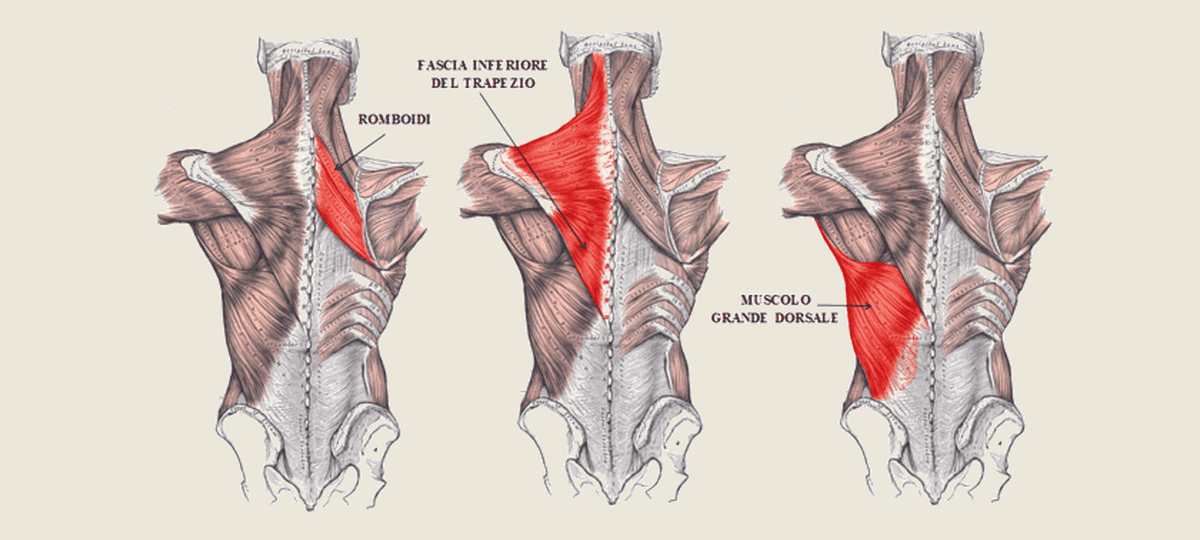
The trapezius nearly always tightens on the same side, and that is not an accident: it is the side that carries, pulls and holds for both. Massage, heat and stretching bring real relief, but it is brief, because they treat the tired muscle without ever addressing the disconnected one. Relief lasts when who does the work changes.
Bring a hand to the base of your neck, where the shoulder starts to rise. Press. Now do the same on the other side.
Not the same, is it? One gives under your finger, the other answers like a tight rope. And I’d guess you already knew which one, before you even touched yourself.
The trapezius doesn’t tighten at random. It locks on the side that carries the weight of two — which is exactly why it keeps coming back after the best massage of your life.
An honest note first: this is educational work, not therapy. If your pain is severe, persistent, wakes you at night or travels down your arm, the first thing to do is get assessed by a doctor or a physiotherapist. What follows is about how tension organises itself, not about treating a condition.
Anatomy
Where the trapezius is, and what it actually does
The trapezius is a large flat muscle running from the base of the skull, down along the spine to mid-back, and out toward both shoulders. Seen from behind it looks like a kite — hence the name.
It has three portions with different jobs. The upper fibres — the ones you just touched, between neck and shoulder, where the pain almost always shows up — lift the shoulder and support the head. The middle fibres draw the shoulder blades together. The lower fibres pull them down.
Hold on to that first job, because it explains nearly everything: the upper trapezius is the muscle that holds. It holds your head, it holds your bag, it holds the shoulder steady while the arm works. A muscle that holds never gets a moment to switch off — and a muscle that never switches off ends up in permanent grip.
The distinction
Tightness, strain or inflammation: what’s the difference
Three words used interchangeably that describe different things.
A trapezius strain is an acute shortening: the muscle clamps suddenly, usually after an effort or a sharp movement, and stays hard. You recognise it because it has a start date — you know when it arrived.
An inflamed trapezius is something else again: there is heat, sometimes swelling, and pain even when you are still. This is medical territory, and a professional should look at it.
A chronically tight trapezius has no start date. It is a constant, low-level grip that has been there for years, doesn’t wake you at night, and that you have stopped noticing. That is the one you live with, and the one Bilateral Education has something to say about.
The distinction matters because it changes what helps. An acute strain settles in days. Tightness that has lasted for years doesn’t settle at all: it has become the posture your body rests in.
The point
Why it’s nearly always the same side
Ask anyone with trapezius pain which side it’s on. They answer instantly, without thinking. Nobody says “it varies”.
That should be suspicious. A problem that always picks the same side isn’t a problem with the muscle: it’s a problem with distribution.
Your body has two identical trapezius muscles. There is no anatomical reason for one to tighten and the other not to. The reason is use: one of the two has become the specialist that holds for both, while the other stopped being called on. And as we describe when talking about motor coordination, the quiet side isn’t weaker — it’s just disconnected.
So the aching trapezius isn’t the victim. It’s the worker covering two shifts. And until the other one comes back to work, no amount of massage will hold.
The causes
The three daily gestures that load the trapezius
You don’t need an injury. You need repetition.
The bag. Always the same shoulder, isn’t it? To keep it up there, that trapezius has to stay lifted for the whole walk. The weight isn’t the problem: the problem is that the contraction never ends.
The working arm. Mouse, phone, steering wheel, scissors, spatula. Every time one hand does something precise, the shoulder on that side stabilises to allow it. Eight hours at a desk is eight thousand micro-contractions, always on the same side.
The turn of the head. The second monitor is on the right. The window is on the left. The television sits at an angle to the sofa. Your head stays slightly rotated for hours, and the trapezius is what holds it there.
None of these gestures is wrong. The problem is that they all happen on the same side, and none of us has ever thought to alternate them. Elective lateralization — consciously choosing a side rather than being subject to one — begins exactly here.
The misunderstanding
Why massage and stretching relieve but don’t resolve
Massage works. For three days. Then that rope pulls tight again, in exactly the same place.
It isn’t that massage is wrong: it’s that it is treating the one who works too much, not the one who doesn’t work enough. As long as the load stays distributed the way it is, that side will tighten again, because it is the only one your body knows how to use.
The same goes for stretching. Lengthening a gripping trapezius feels excellent and lasts a few hours, because a muscle with a job to do cannot afford to stay long. It will go short again, because it has to.
Have you ever caught yourself saying “I finish physio and two days later I’m back where I started”? It isn’t that physio doesn’t work. It’s that trapezius tension isn’t a knot you untie once: it’s a behaviour. And behaviours return until you change what produces them.
The practice
Three minutes to feel the side that isn’t working
Before you change anything, you have to notice what is happening. This isn’t a cure: it’s a way of seeing.
- Compare. With your fingers, press above the right shoulder, then above the left. Don’t hunt for pain: look for the difference in texture. One yields, the other resists.
- Lift and drop. Raise both shoulders toward your ears, hold for five seconds, then let them fall all at once. That small soft collapse is what a muscle does when it has finished. Notice whether one side collapses less than the other: that is the side that doesn’t know how to stop.
- Reverse one gesture. For the rest of the day, carry your bag on the other side. It will feel awkward, unstable, wrong. That clumsiness isn’t weakness: it’s a side that hasn’t been given a job in years and doesn’t yet know how.
If you want a fuller map of how you distribute your body, the side test is built for it: eight questions that don’t measure how good you are, but how much you know about what you do every day without noticing.
The third point is the most important, and it’s also the one almost nobody does. You aren’t training the weak side: you are giving it back a job. It’s a subtle difference and it changes everything, because the gripping trapezius will only let go once it stops being solely responsible.
When to seek help
When you need a doctor
There is a line, and it should be stated plainly. See a professional if:
- the pain came on suddenly and severely, with no cause you recognise;
- it wakes you at night, or never changes in any position;
- it comes with tingling, numbness or loss of strength in the arm or hand;
- there is swelling, heat or fever;
- it appeared after a fall, a blow or whiplash;
- it has lasted more than a few weeks with no improvement at all.
The neck carries important nerves and vessels: some pain that feels muscular isn’t. Educational work on movement makes sense after someone has ruled out the causes that need something else.
FAQ
Frequently asked questions
Why is my trapezius pain always on the same side?
Because that side carries for two. Bag, phone, mouse, the turn toward a screen: gestures you repeat on the same side, with the trapezius there engaged for hours. It isn’t stronger or weaker than the other — it’s simply the only one your body knows how to use for that job.
What’s the difference between tightness, strain and inflammation?
A strain is a sudden, acute shortening tied to a specific effort. Inflammation brings heat, sometimes swelling, and pain at rest — that’s medical territory. Chronic tightness is quieter: a constant grip that has been there for years and that you take for granted.
Why does massage only help for a few days?
Because it treats the one who works too much, not the one who doesn’t work enough. It releases the gripping muscle, but then you return to your life with the same distribution of load. The tension rebuilds because the reason it existed hasn’t changed.
What exercises help a tight trapezius?
Direction matters more than the specific exercise: first release the gripping side with very slow movement, then give the disconnected side a real job on the same task the strong side handles today. Stretching only the painful side relieves, but it doesn’t change who carries the load.
How long does it take?
Immediate relief can come in a single session. But for it not to return you need weeks, because you are changing a motor habit built over years — you aren’t repairing a fault.
In short
What it comes down to
The trapezius that hurts isn’t broken. It’s tired, and it’s tired because for years it has covered two shifts. You can loosen it each time with a massage — and you should, the relief is real. But if you want it gone, the road is different: give work back to the side you left behind, so the tired one can finally let go.
Start with the Test to see which way you’re imbalanced, then look at the Method to understand how you take away before you build. One body, two sides — and a shoulder that releases once you stop asking it for everything.
From the shoulder to the gesture
Stop releasing the same side over and over. Bring the other one back into play.
A massage relieves; rebalancing the two sides makes it last. The first step is to see which side you’re imbalanced on — and for that there’s the method, and, if you like, a session together.