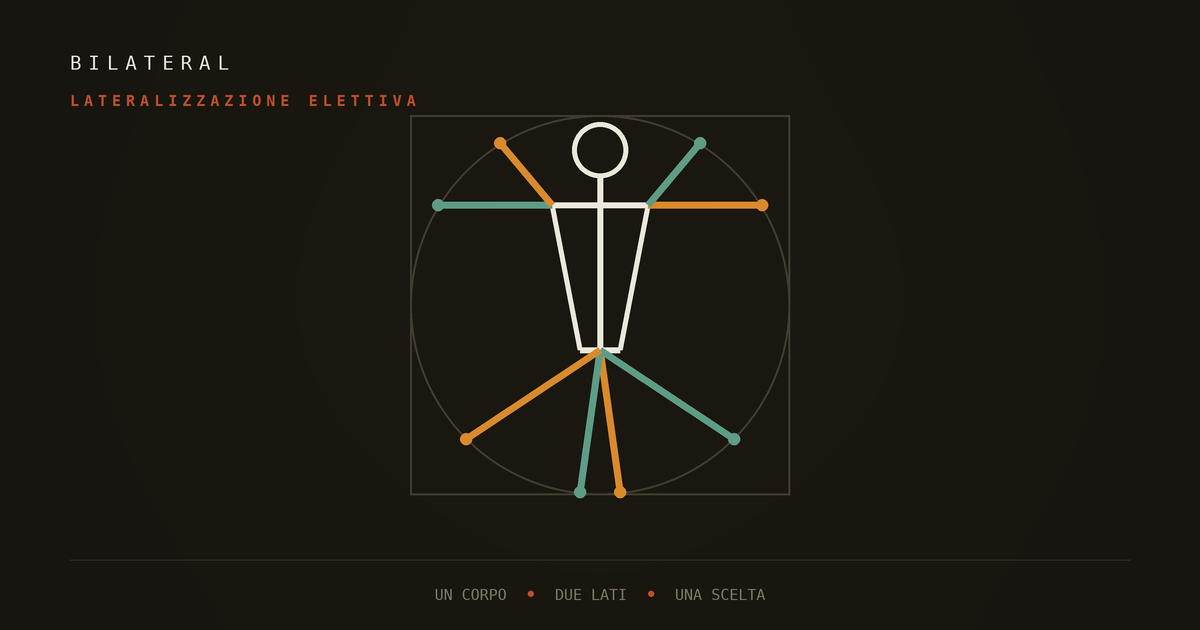
Elective lateralization is the trained capacity to choose which side of the body leads a gesture, instead of suffering one out of habit. It doesn’t abolish dominance nor impose symmetry: it turns it into a choice. It’s the term Bilateral Education uses to tell real ambidexterity — possible and chosen — apart from mere double dexterity.
There’s a word missing from the vocabulary of the body. We have «right-hander» and «left-hander» for those with a compulsory side; we have «ambidextrous» for those who seem to have none. But the name is missing for the most interesting thing: not having two identical sides, but being able to decide, gesture by gesture, which one leads. That capacity now has a name: elective lateralization.
The definition
What elective lateralization is
The adjective is chosen with care. Elective comes from the Latin eligere, to choose — the same root as «election» and «elective subject»: something you elect, not something you undergo. Elective lateralization is therefore a laterality you choose. Not one side fewer, not two sides made identical: one more side you can call on, and the freedom to decide which.
The decisive point is this: it isn’t a state, it’s an operation. Not «I am electively lateralized» the way one says «I am right-handed». You perform it, gesture by gesture, the way you keep attention awake. We’ll return to this, because it’s the difference that sets this concept apart from every naive version of ambidexterity.
Three conditions
Suffered dominance, imposed symmetry, elective lateralization
A side of the body can be in three different conditions, and only the third is the one we’re after.
1. Suffered dominance. It’s the default condition, and the most common. One side leads almost everything, and you didn’t choose it: you found it there. The sign that it’s suffered and not chosen is simple — try any gesture with the other side and you’ll feel how clumsy it is, how it «won’t start». The silent side isn’t incapable: it’s held back, and you have no say.
2. Imposed symmetry. It’s the naive fix: if the problem is having a dominant side, let’s abolish it — make the two sides identical. But here you throw the baby out with the bathwater. The two sides don’t do the same thing redundantly: the neuroscientist Robert Sainburg calls it complementary dominance — one side specializes in quick, direct gestures, the other in stability and fine control. Erasing the difference doesn’t free you: it takes a tool away. Symmetry is not the goal.
3. Elective lateralization. The third path neither removes nor levels: it elects. You keep the difference between the two sides — with their specializations — but you gain the choice of which one leads, when needed. The strong side isn’t weakened; the weak side is connected, so both stay available. Not a symmetric body: a reversible one.
It’s the same scale our side test measures: clear dominance, mixed dominance, bilateral body. Mixed dominance — different sides for different gestures — looks like the goal, but it isn’t: it stays distributed dominance, each gesture with its compulsory side. It lacks the one thing that counts: noticing it as it happens, and being able to decide otherwise.
The presupposition
Before the choice: connection
There’s a condition that comes before everything, and that we long misunderstood ourselves. It isn’t true that subtractive work presupposes additive work, nor the reverse. Both presuppose connection — which is neither additive nor subtractive, but the condition of possibility of both. Connection, here, is another word for bilaterality: the same thing seen from two sides.
Feel what this means concretely. A connected chain does three things in order: it loads (gathers force at one end), transmits (carries it through the body) and sets down (releases it at the other). An arm that pushes a wall while staying slack loads nothing: the force leaks along the way. A side that can’t let a tension go is anchored: it doesn’t set down. In both cases there’s no chain — and with no chain there’s no side to elect.
That’s why the real entry question isn’t «which side?», but «is there a chain?». First you look at whether the gesture loads, transmits and sets down; only then does it make sense to ask which side should lead it. The choice comes after connection, never before.
Two paths
How you reach the choice: additive and subtractive
With the side connected, two roads remain — complementary, not alternative. The additive path builds the missing ability by repetition: you train the weak side at the same task as the strong one. The textbook case is the footballer’s weak foot, trained to strike like the strong one — not a different task, the same task from the other side.
The subtractive path doesn’t add: it frees a symmetry already present, by reducing the chronic contraction holding one side hostage. It’s release — the loosening of Yang-style Taiji, read through a bilateral key. Careful: it isn’t «relaxing». Tension doesn’t switch off, it migrates: tone is a loan, not a property. You take it from where it obstructs so it becomes available elsewhere.
Two paths, one end: to make the side electable. The additive gives the weak side an ability it lacked; the subtractive gives the body back a symmetry it had and kept locked. Both end in the same place — the possibility of choosing.
The neural correlate
The gate: what happens in the brain when you «give permission»
That «permission» the weak side seems to wait for isn’t a metaphor: it has a measurable correlate. Before a movement, the commanding hemisphere opens a gate — interhemispheric inhibition lifts — a moment before the gesture. On the non-dominant side that gate opens late, or doesn’t open. It’s long documented (Ferbert 1992; Duque 2007; Liuzzi 2010-2011): the same asymmetry you feel as clumsiness has, underneath, an asymmetry of neural timing.
Listen to the difference between two words Bilateral Education keeps apart. The gate is a discrete, very brief event — the click of a railway switch, tens of milliseconds — that opens the way to one side. The mode is the sustained state that follows: a stance, a guard held over time. Elective lateralization is being able to open the gate you want, when you want — and to hold the mode you chose.
Not a state
It isn’t a state, it’s an operation
Let’s return to the point left hanging. Being right-handed is a state: you carry it even in your sleep. Elective lateralization isn’t. It resembles lucidity, or attention: you exercise it, lose it in a moment of distraction, re-establish it. It’s not a trophy you win once — «now I’m ambidextrous» — but an operation you repeat: notice the automatism, suspend it, choose.
It’s why, in Bilateral Education, the body schema — in Merleau-Ponty’s sense — isn’t a fixed map to possess, but something re-enacted each time. The body doesn’t «be» bilateral: it becomes so, for the instant you choose it.
Two counterexamples
The pianist and the robot
Two cases help bound the concept, precisely because they don’t satisfy it. The pianist has a symmetry of skill between the two hands few ever reach: necessary, one might say. And yet it isn’t enough. You can be a virtuoso at the keyboard and remain wholly unable to choose the leading side outside that one over-trained gesture. Symmetry of dexterity isn’t election: it’s the starting condition, not the operation.
The robot is the other limit. It has a perfect bilateral symmetry — the two arms identical to the millimetre — and for exactly that reason it’s an empty mirror: structure without history, a symmetry no chain ever loaded and set down. Elective lateralization isn’t clean symmetry: it’s a relation between two sides that have a history, and that can trade the task. The robot has the form and not the operation; the pianist has half the operation and believes it complete.
Try it
Try it yourself
The concept lands in thirty seconds, but only with the body.
Put a glass on the table, a little away. Reach out and take it — without thinking. Watch which hand set off: it went on its own, before you decided. That’s the gate opening on the dominant side. Now put the glass back and take it again, but with the other hand, on purpose. Feel the micro-delay, the extra effort, the «permission» that arrives late. That delay is the gate you don’t yet own. Noticing it is the first act of election: you’ve just chosen a side instead of suffering it.
FAQ
Frequently asked questions
What is elective lateralization?
It’s the trained capacity to choose which side of the body leads a gesture, instead of suffering one out of habit. It doesn’t abolish dominance nor impose symmetry: it makes it a choice. It’s a term coined by Bilateral Education.
What’s the difference between elective lateralization and lateral dominance?
Lateral dominance is suffered: one side leads everything without your having chosen it, and often you couldn’t do without it. Elective lateralization keeps the difference between the two sides but gives you back the choice of which one leads, gesture by gesture.
Is elective lateralization the same as ambidexterity?
It’s what ambidexterity should mean. Not being equally skilled with two hands redundantly, nor cancelling dominance into an imposed symmetry, but being able to choose the leading side. Elective lateralization is ambidexterity understood as choice, not as double dexterity.
Who coined the term elective lateralization?
The term was coined by Jacopo Fedeli within Bilateral Education, out of an experimental philosophy thesis and a subsequent paper. The research has a Zenodo DOI and can be consulted in the research.
How do you train elective lateralization?
First you check connection — that there’s a chain able to load, transmit and set down the gesture. Then you choose between two paths: the additive one, which trains the weak side at the same task as the strong, and the subtractive one, which frees a symmetry already present by reducing chronic tension. The path is described in the method.
In short
In short
A side can be suffered, levelled or elected. Suffered dominance you didn’t choose; imposed symmetry throws away the difference you need; elective lateralization keeps the difference and gives you back the choice. It isn’t a state you possess, but an operation you perform — notice the automatism, suspend it, choose — and it rests on a single condition: that the side be connected. This, and not double dexterity, is the heart of ambidexterity.
If you want to see where it comes from, you’ll find it in the research; if you want to understand how you reach the choice, start from how to become ambidextrous.
From the word to the body
A new term for an old thing: being able to choose the side.
You have the concept; the rest the body learns. The first step is to notice the leading side — and for that there’s the method, and, if you like, a session together.