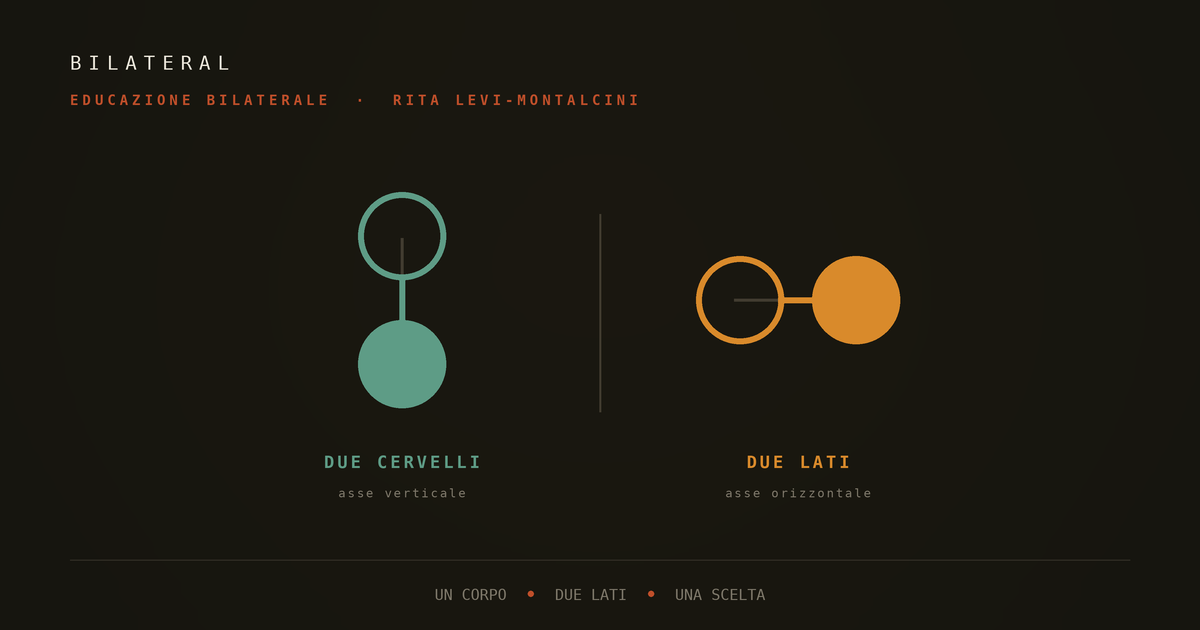
«Bilateral education» means two different things. For Rita Levi-Montalcini it’s the education of the two brains — the emotional and the rational. For Jacopo Fedeli’s Bilateral Education it’s the work on the two sides of the body, up to elective lateralization: being able to choose which side leads. They’re homonymous but independent concepts. Between them there’s a precise relation: the body is the concrete step from which to begin educating those two natures. An extension of her idea, not a correction — on one condition: without the «two hemispheres» myth.
In one line: Rita Levi-Montalcini educates the two brains; Jacopo Fedeli’s Bilateral Education educates the two sides of the body.
A shared name
Why searching «bilateral education» brings up her
There’s a coincidence to face head-on. Whoever searches «bilateral education» meets, almost at once, Rita Levi-Montalcini — and rightly so. It’s a name that carries weight: Nobel laureate in Medicine, the scientist who discovered nerve growth factor. If a word sits next to her, the honest first move isn’t to claim it: it’s to ask whether we’re saying the same thing. The answer is no — and that very «no», looked at closely, says something interesting about both.
The two brains
What Rita Levi-Montalcini meant by bilateral education
At the base is her thesis of the two brains. On one side an archaic brain, ancient, shaped by millions of years of evolution: seat of the emotions, born for the survival of the species, able to act silently, masked behind the appearances of language. On the other a cognitive brain, recent — the neocortex —, fed by culture, responsible for reasoning.
Hence her idea of education: not the mere transmission of notions, but a work that holds both brains together — reason and emotion. «Bilateral» because it refuses to train only the intellect, leaving the emotional life to itself. A message Rita Levi-Montalcini addressed above all to the young and to those who educate them.
Two honest caveats: the label «bilateral education» circulates mostly in the popularization tied to this two-brains thesis; and placing emotion «in the hippocampus» is a simplification — the limbic system is broader. But the core, educating the two natures of the mind, is firmly hers.
The two sides
What Jacopo Fedeli’s Bilateral Education means
Jacopo Fedeli’s Bilateral Education uses the same word in a more literal, lower sense: the two sides of the body, right and left. Not two brains layered by evolution, but two halves symmetric in space. The theme isn’t integrating emotion and reason, but something apparently more modest: that both sides be connected and available, instead of one ruling out of habit and one held back.
The aim has a name: elective lateralization — being able to choose which side leads a gesture, instead of suffering one. Not abolishing dominance, not making the two sides identical, but making them electable. A work that begins from the gesture and from muscle tone, not from self-awareness.
Two axes
The decisive difference
That’s why they aren’t the same thing. The «two» of the two bilateral educations falls on different axes. Rita Levi-Montalcini’s is a vertical axis: two evolutionary layers, the emotional below and the rational above. Jacopo Fedeli’s Bilateral Education is a horizontal axis: right and left, the bilateral symmetry of the body. She speaks of minds; Bilateral Education of sides. She of pedagogy; the other of movement. Same label, different objects: homonymous but independent. Fedeli’s method doesn’t derive from Levi-Montalcini’s thought — it’s born from an experimental philosophy thesis and the practice of Taiji.
That said, the kinship isn’t fake. Both use «bilateral» to say the same deep thing: don’t privilege one half, cultivate both. Both arise against a default imbalance — all-cognitive education on one side; the dominance of a single body-side on the other. And both refuse amputation: neither wants to eliminate a half, but to make it available.
An extension
An extension, not a correction
And here the relation gets interesting. There’s a point where Jacopo Fedeli’s Bilateral Education extends Rita Levi-Montalcini’s idea, adding the term she lacks. Her model is, in fact, a work from above: becoming aware of the two natures of the brain, educating them, integrating them. But it says what to educate, not where to begin. The body — the gesture, the tone, the side — stays in the background. And it’s precisely the body that is the missing concrete step.
It isn’t an arbitrary addition. For Merleau-Ponty the mind isn’t above the body: it’s made through the body, through the body schema. For Varela cognition is enaction — embodied knowledge, happening in moving and perceiving: it’s neurophenomenology, one of the roots of this method. In this light, the two natures Rita Levi-Montalcini speaks of — the emotional and the rational — don’t live somewhere outside the body that the body then executes: they’re exercised in a body. And a body is lateralized, trained from one side or the other.
So beginning from the gesture means addressing from below what she addressed from above. Bilateral Education doesn’t contradict the education of the two brains: it offers it a concrete, trainable foothold. First the body — then, on that connected body, the rest.
The honest caveat
It isn’t the two-hemispheres myth
Here a brake is needed, and I put it in writing because seriousness demands it. It would be easy — and wrong — to say: «if I lateralize to the left side I use the creative brain more». That sentence is the famous two-hemispheres myth — right creative, left logical — and it must be said plainly that it doesn’t hold.
A 2013 study of over a thousand brains (Nielsen et al., University of Utah) found no evidence that people preferentially use one hemisphere over the other. Creative thinking, in particular, activates widespread networks across both hemispheres working together: creativity is not a hemisphere. It’s a myth as widespread as it is debunked — still believed by the great majority of teachers worldwide, and it’s exactly the ground Bilateral Education wants to stay clear of.
The grain of truth the myth inflates does exist: motor control is contralateral — the left side of the body is governed by the right hemisphere, and vice versa. That’s real. But the leap from «I activate one side’s motor cortex» to «I become more creative» has no basis. And there’s a conceptual reason: the two axes don’t coincide. Levi-Montalcini’s is vertical (emotional/rational), laterality is horizontal (left/right). Saying «lateralizing to one side switches on the emotional or creative brain» secretly fuses two different dichotomies. They aren’t one. That’s where the argument breaks.
The real bridge
From body to emotion, without shortcuts
If the bridge between body and emotion isn’t «the creative hemisphere», what is it? Two real things, sturdier than the myth. The first is interoception: emotions are rooted in bodily states — it’s the lesson of Damasio’s somatic markers and of Varela’s enaction. You feel in the body first, and on that feeling emotion is built. Working on the body is thus a concrete, bottom-up access to what later becomes emotion and attention.
The second is already inside the method, and it’s measurable: the gate, interhemispheric inhibition. Training the non-dominant side or releasing chronic contraction doesn’t «switch on» a creative hemisphere, but changes how the two hemispheres yield to each other — and this is measured (Duque et al.). It’s an honest neural story, and therefore falsifiable: it holds as long as the data hold it, and falls if they refute it. We don’t need the myth: we have better, because it’s true.
In short
In short
Jacopo Fedeli’s Bilateral Education is not Rita Levi-Montalcini’s: she educates the two brains — emotional and rational —, Bilateral Education the two sides of the body. Homonymous, not direct relatives. But her idea can be extended, adding the step it lacks: the body, as a concrete starting point for a work that later touches emotion and intelligence. An extension, not a correction. And all this can be said without falling into the two-hemispheres myth — indeed, saying it while refusing that myth is what makes the path credible.
Look at the difference in one line: she starts from the mind and seeks the body; Bilateral Education starts from the body and reaches the mind, from below.
FAQ
Frequently asked questions
Is Jacopo Fedeli’s Bilateral Education the same as Rita Levi-Montalcini’s?
No. They’re homonymous but independent concepts. Rita Levi-Montalcini called «bilateral» the education of the two brains — emotional and rational. Jacopo Fedeli’s Bilateral Education concerns the two sides of the body, motor laterality and elective lateralization. Same word, different objects.
What did Rita Levi-Montalcini mean by bilateral education?
The idea that the brain has two natures — an archaic, emotional one and a recent, cognitive one — and that education must develop both, reason together with emotion, instead of training the intellect alone.
If I use my left side more, do I become more creative?
No. It’s the «two hemispheres» myth (right creative, left logical), refuted by research: creativity involves widespread networks across both hemispheres. It’s only true that motor control is contralateral — the left side is governed by the right hemisphere — but no increase in «creativity» follows from that.
In what sense does Bilateral Education extend Levi-Montalcini’s idea?
Rita Levi-Montalcini describes what to educate (the two natures of the brain) but starts from above, from awareness. Jacopo Fedeli’s Bilateral Education adds where to begin: the body. Since emotion and cognition are embodied, training the body is a concrete starting point for the rest.
From the mind to the body
Two natures, two sides — and one place to begin: the body.
If the bottom-up path convinces you, the first step is to notice the leading side — and for that there’s the method, and, if you like, a session together.